

Sukkot
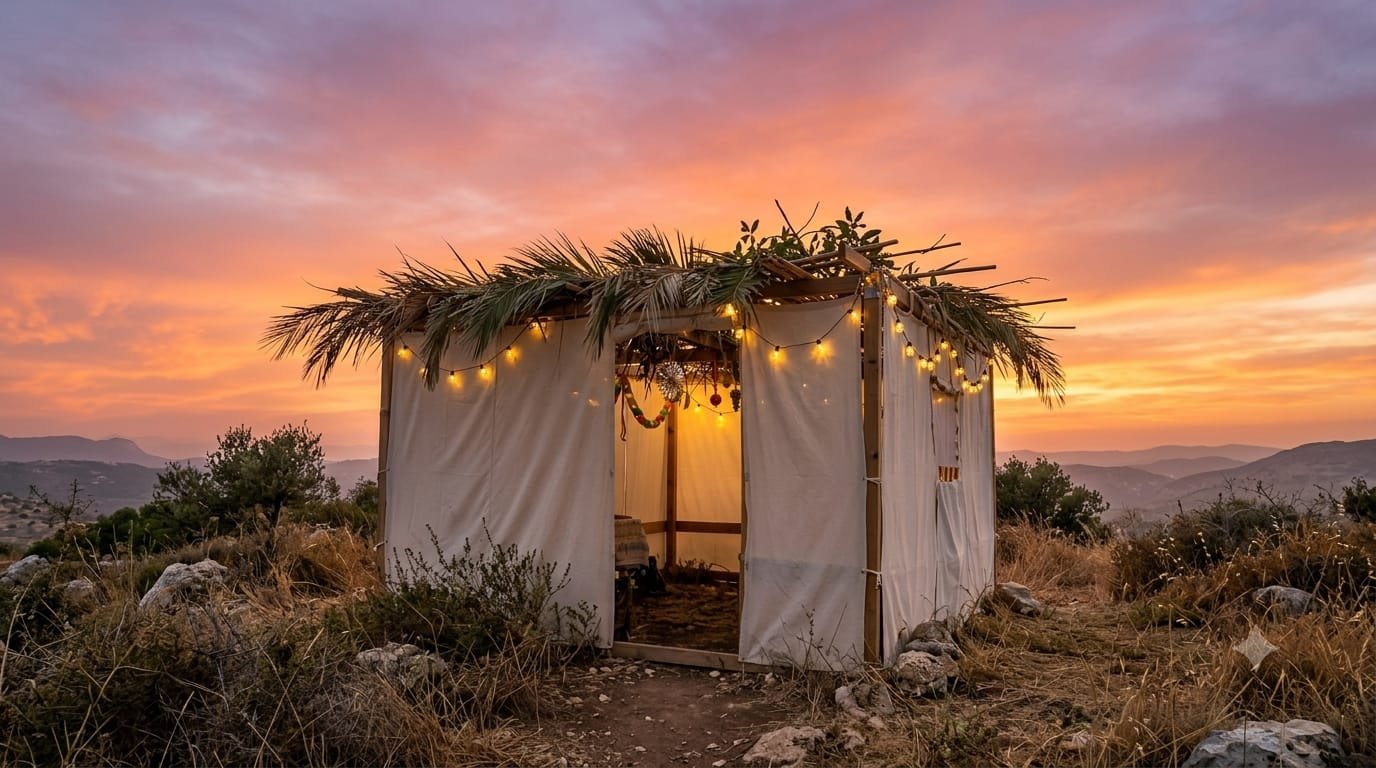
Sukkot: Our Annual Retreat
Weekly Wisdom for Sukkot by Avigail Be'eri-Harel | On the balance between comfort and inner freedom.
Returning from a meaningful retreat, a period of wandering and spiritual searching, or a backpacking trip brings up profound questions about bourgeois life: are a steady job and living in secure homes truly the best life we can ask for?
On the one hand, many spiritual traditions argue they are not. At their core lies the value of homelessness: property, possessions, material security, and even our relationships are perceived as bonds of attachment that distance us from real life and the sublime. Consider, for example, the story of the Buddha, who abandoned his protected palace and family life in favor of nomadism and material impermanence, with the purpose of freeing himself from suffering. On the other hand, most of us do not desire a life of renunciation. Our lives rely on values of partnership, family, community, social and political involvement, earning an honorable living, and repairing the world (Tikkun Olam).
What does the Jewish tradition teach us about this tension?
The Torah commands us to remember the period of wandering in the desert and dwelling in booths: "You shall dwell in booths seven days [...] that your generations may know that I made the children of Israel to dwell in booths, when I brought them out of the land of Egypt" (Leviticus 23). There is immense value—precisely after arriving in the land and settling in permanent homes—in instilling this move out to the Sukkah across generations, in order to evoke memories of nomadic life. How can we understand this?
In his book Sod Yesharim, the Radziner Rebbe, Rabbi Gershon Henoch Leiner, explains that our permanent house indeed constricts our consciousness: "Even though it protects a person from stream and rain, nevertheless, one sitting inside a house does not feel that protection, because the thickness of the ceiling conceals what is outside, so that one does not perceive it." In other words, the problem is not the protection itself, but the opacity and seal.
In contrast, the Sukkah evokes clear consciousness and gratitude precisely because it is not sealed tight, as "one who sits inside it perceives its protection, for one clearly feels how the Sukkah protects them from the stream and rain outside" (Shabbat Chol HaMoed Sukkot 6).
The Sukkah reveals to us that there is an intrinsic, inherent connection between consciousness, openness, and vulnerability. It shows that it is impossible to gain sensitivity, inner freedom, love, and true gratitude without agreeing to be a little vulnerable and risking getting wet from the rain. The Sechach (roof covering) of the Sukkah is a roof that is not opaque, through which we can experience divine presence and providence, while also getting wet. When we are overly protected behind thick ceilings, the heart becomes sealed.
The festival of Sukkot acts like a short annual retreat. We step out for a week from our permanent, comfortable lives to remember impermanence and vulnerability, to remember that it is possible to open the heart, and to practice gratitude instead of constriction. But this has a limited time—we do not remain in the desert or renounce the world. From there, we return back to our permanent home and to practical life. While our skin is still sensitive and our heart is open, the question is not how we escape routine, but how we bring the consciousness of the Sukkah and everything we learned into our life at home.